business@webideasole.com

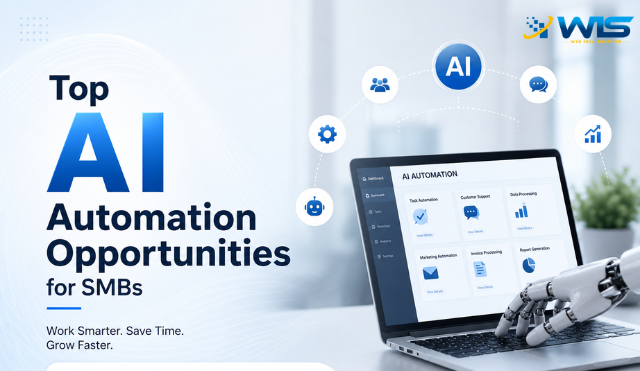
Is your business team losing an entire workday every week without anyone noticing?
While someone is busy copying leads from WhatsApp into a spreadsheet, another one is sending follow-up emails manually. The accounts team is matching invoices while the sales team is answering the same question again & again.
This is a common scenario within SMBs.
However, modern SMBs with smart growth objectives have already started to invest in AI automation for small businesses. According to a Salesforce report, around 75% of SMBs surveyed were investing in AI in 2025.
So, where should an SMB actually start?
AI automation for small businesses means using smart software powered by artificial intelligence to handle repetitive, manual tasks.
Unlike old automation that only follows strict rules, integrating AI into existing business software can read messy human text, make simple choices, and learn from data to provide well-researched decisions. Basically, it acts as a digital helper for small businesses to save time and cut costs.
Traditional automation follows predefined rules:
If X happens → do Y.
AI-powered automation can work with less structured information and make context-based decisions:
Understand X → determine what it means → choose the appropriate action → execute it or ask a human.
That difference is what makes business process automation with AI particularly valuable for growing companies.
Not all AI projects are worthy of investment. The most promising projects can be found where there is repetition, lots of data, urgency, or a need to transfer data from one system to another.
The lead remains in the inbox until someone views it the following day without automation. By then, the prospect will have gotten in touch with three other companies.
An automated lead workflow will be able to extract the content of the inquiry, filter out any important information, detect buyer intent, give a lead score, and enter all that data into the CRM.
This makes lead management one of the most practical AI automation use cases for businesses.
Another obvious area where AI could be used is in customer support, since companies get many queries that do not really need a human agent at all.
AI agents can provide answers to frequently asked questions by using official information from the company, find out customer information, and pass on special cases to a human agent.
This could prove particularly helpful for SMEs.
However, CRMs usually include many details that people do not have time to keep track of.
With AI, these interactions and activities can be turned into CRM data.
For example, one can develop a workflow that would summarize a sales call, determine customer needs, update the sales cycle stage, and set up follow-up actions.
Finance departments have plenty of documents, routines, and processes to go through.
AI can extract data from invoices, categorize expenses, spot discrepancies, and route the document for further approval. It can also assist in reconciling data from different accounting systems and identifying transactions for human verification.
The task of recruitment produces quite a bit of paperwork.
Gathering applications, filtering resumes based on pre-set criteria, conducting interviews, addressing queries from candidates, and maintaining records can take up quite a lot of time on the part of a small HR department.
And that is where AI development comes into play.
Businessmen usually do not lack information.
They lack time to analyze this information.
The role of AI in this case is to collect information from various sources like CRM, sales, accounting, marketing, and operations and convert this information into useful reports.
The important shift is from:
Data → dashboard
to:
Data → interpretation → recommended action.
Your staff may be frequently reading documents and transferring information to another database system; this means that your process is ripe for automation.
Purchase orders, forms, quotations, applications, contracts, and delivery documents can frequently be processed using AI-based document extraction.
It analyzes the document, extracts the required information and delivers it to the right application.
Operations get complex in the presence of several individuals, processes, and approvals.
An order might require going through sales, inventory, procurement, dispatch, accounting, and finally informing the customers.
AI can be there between all of these and assist in the coordination of the process.
|
|
|
|
|
|
|
|
|
|
|
|
|
|
|
|
|
|
|
|
|
|
|
|
|
|
|
|
|
|
|
|
Automated AI technology can no longer be limited to corporations that have hefty budgets for technological innovation.
The true value proposition for the SMB lies in its simplicity: locating areas of tedious operations that hamper the productivity of the company and then integrating them with appropriate AI functions.
So, if you are thinking of AI automation for your SMB, connect with professionals at Web Idea Solution.
We will help you understand which business process AI should take off your team's plate first.
AI-based automation makes use of artificial intelligence to complete mundane business tasks with little involvement on the part of the individual. Some of the things that AI automation can be used for include customer support, lead generation, documentation, reporting, and CRM management.
With the use of AI, less manual labor is needed for repetitive tasks, enabling employees to engage in more value-adding tasks. In addition, processing time is reduced, and human errors are minimized.
Some of these areas include lead management, customer service, sales follow-ups, invoicing, document processing, marketing, human resource management, report writing, and internal knowledge management. It is up to the individual firm to determine which option will work for them.
There are processes in small businesses where automation takes place through the repetitive processing of data, decision-making, and communication. Examples include lead generation, email processing, customer support, CRM updates, invoice extraction, appointment scheduling, and business reports.
Absolutely. The AI system can instantly answer any question posed by customers and also guide customers through any order or service-related issue. The system will also help route complex queries to the right employee.
AI can help capture and analyse leads, understand customer intent, score leads and initiate personalized follow-up. When combined with a CRM, it can also help update the customer record and notify the sales team that the lead is ready for human interaction.
Indeed. AI can help in the process of segmenting customers, creating content, customizing campaigns, nurturing leads, and analyzing their performance. In doing so, it can help marketing teams make relevant communications without having to do repetitive tasks.
There is no fixed price since the price will be based on the type of workflow, integration required, AI technology used, and the level of customization needed. An enterprise can begin using low-cost out-of-the-box AI software solutions; however, more complicated workflows might need customized AI automation.
The major risks associated with AI include inaccuracies in AI output, privacy concerns in data, security risks, integration challenges and overdependence on automation. Organizations should establish controls, measure AI performance and maintain human supervision for decisions with high impacts. The NIST AI Risk Management Framework advocates for management of risks associated with AI throughout the system’s lifecycle.
Identify a repetitive task that consumes the most time of your employees in large volumes. Document the current process flow, set a metric goal and apply the right type of AI to perform the task after human approval



Reach out, we’d love to hear from you!