business@webideasole.com

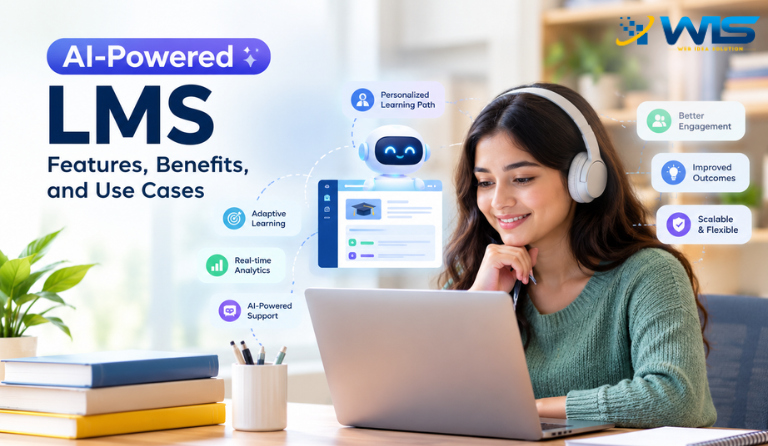
Want to make a smart learning management system that responds to learners’ challenges before they affect learning outcomes?
Then an AI-powered LMS is your solution. It goes beyond delivering courses online. An AI-powered LMS can personalize learning paths, provide instant support through AI tutors, automate assessment tasks, and help educators identify knowledge gaps.
For schools, universities, EdTech companies, and businesses, this means creating learning experiences that adapt to people.
But which AI features actually make a difference and how can organizations implement them effectively? Let’s explore essential features, benefits, real-world use cases and development considerations below!
An AI-powered LMS is a software application that uses artificial intelligence to enhance the process of education delivery, assessment, management, and personalization.
Generally, an AI LMS platform allows the administrator to upload classes, allocate lessons, test students, check the attendance rate, and keep tabs on the completion rate. However, an AI-powered LMS can take this further through the identification of learning gaps, learning resource recommendations, assessment question generation, and conversational support.
But is education ERP and LMS the same? Check education ERP vs LMS clearly.
|
|
|
|
|
|
|
|
|
|
|
|
|
|
|
|
|
|
|
|
|
|
|
|
|
|
|
|
An intelligent platform cannot be achieved simply by having a chatbot; rather, it is defined by how effectively its features address real-life issues in terms of learning and operations.
Below are seven features that may be useful in developing an AI learning management system.
Not all learners will be equally comfortable with the same course layout. While some learners pick up on ideas instantly, there are others who may need extra examples and practice to fully comprehend them.
With the help of an AI-assisted LMS, assessment scores, performance throughout the course, and learning styles of students can be analyzed in order to provide appropriate materials for the learner.
Adaptive learning and personalization are related but not synonymous. Personalization could mean content recommendation based on user profile while adaptive learning involves changing the learning process as a function of performance.
But the quality of adaptation depends on the system’s learning rules, assessment design, and the reliability of the data it uses.
An AI tutor in an LMS can provide conversational explanations, answer questions related to the course, give tips and assist students with complex topics. If properly designed, an AI tutor may even pose follow-up questions for the learners to enhance their comprehension rather than spoon-feed them answers.
Assessment creation, response evaluation, and provision of useful feedback require substantial teacher effort.
The use of AI for assessment in education will assist in generating draft test questions, variations of test questions, identifying recurring mistakes and giving preliminary feedback for some types of written answers.
An excellent LMS chatbot in the educational environment can assist with general queries about courses, due dates, assignments, enrollment, and the LMS itself.
In lieu of repeatedly contacting the administrator about their queries, students have the option to pose their queries via a conversational bot that can respond with an answer or the necessary resources.
Conventional LMS reports may include information about past events such as course completion, attendance, and assessment scores. AI-powered analytics can aid in detecting patterns worth exploring further.
A useful distinction: a prediction is not a fact. Low activity does not automatically mean a learner will drop out, and an algorithm should not make consequential academic decisions without appropriate human review. That’s why the right edtech development company matters.
Creation of high-quality learning material is not just uploading a presentation or recording a lecture. Teachers require explanations, tasks, quizzes, and other types of resources that are linked to specific learning objectives.
The use of AI in LMS allows teachers to create summaries of lessons, quizzes, flashcards, examples, and transform approved source materials into other types of learning material.
The real advantage of AI-powered LMS development becomes clear when its capabilities are connected to measurable organizational needs.
These suggestions generated by the help of AI could be employed for giving more practice, recognizing learning deficiencies for the teacher, and offering explanations for some subjects. However, the lesson planning, evaluation, and decision-making still depend on the teacher.
AI technology can be used in colleges by institutions for tutoring, course recommendation, question generation, and multilingual learning. In addition, integration of AI with students' information systems and current LMS platforms can facilitate unification of both processes.
Organizations can customize their onboarding processes, suggest learning paths for various roles, and automate mundane training tasks. Analytics can assist L&D teams in determining the modules that pose challenges for employees and seeing if they achieve the desired learning outcomes.
EdTech companies and online course providers can offer an adaptive learning process, AI tutors, automatic feedback, and learner engagement processes in their products. All these components can contribute to making a difference from a content repository point of view.
An AI-powered LMS can do much more than automate routine learning tasks. When thoughtfully designed, it can create more personalized learning journeys, provide intelligent learner support, simplify assessments, and give educators and organizations deeper insights into performance.
The key is choosing the right AI capabilities for your actual learning goals. If you are planning to build a custom AI LMS or enhance an existing learning platform with intelligent features, Web Idea Solution can help turn your requirements into a scalable, user-focused solution.
Let’s build an AI-powered LMS that makes learning smarter and more effective.
An AI-powered LMS is a learning management system that uses artificial intelligence to personalize learning, assist learners, automate selected tasks, analyze performance, and improve course delivery.
AI can make an LMS more responsive by recommending relevant content, identifying learning gaps, providing instant assistance, automating routine tasks, and generating useful insights from learner data.
The main features include adaptive learning, AI tutors, personalized course suggestions, AI-assisted assessment, learning analytics, LMS chatbots, automatic content creation, and multilingual capabilities.
Based on an analysis of elements like test scores, progress in class, and the learning process, recommendations for appropriate content or practice can be made.
An AI tutor is a learning assistant in the LMS that is able to answer course-related questions, provide explanations, offer hints, and assist students in performing learning activities.
Yes. AI can help generate questions, evaluate certain types of responses, provide preliminary feedback, and identify common mistakes. Human review is still recommended for subjective or high-stakes assessments.
AI can analyze patterns such as declining scores, repeated incorrect answers, missed activities, or reduced engagement to flag learners who may benefit from additional guidance or intervention.
Yes. An AI-powered LMS can integrate with ERP, CRM, HRMS, student information systems, and other business platforms through APIs or suitable integration frameworks, depending on the systems involved.
It can be, provided the LMS uses appropriate security controls such as encryption, access management, secure integrations, data governance, and defined retention policies. Compliance requirements should also be considered based on the deployment region.
The cost varies based on features, AI capabilities, integrations, user volume, security requirements, and customization. A basic AI-enabled LMS will have very different development and operating costs from a fully custom enterprise platform.



Reach out, we’d love to hear from you!