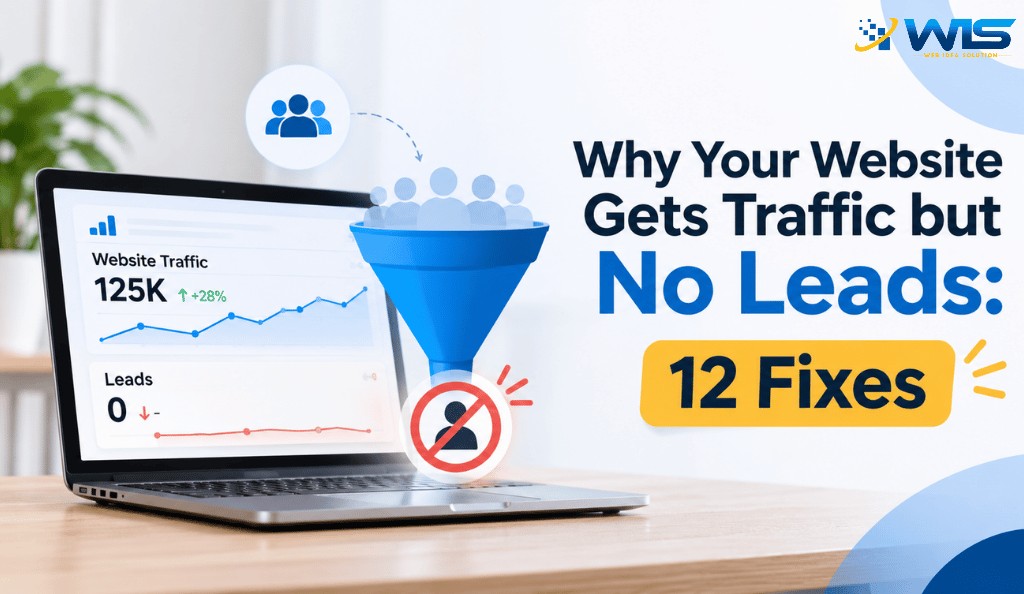
Your website traffic has increased, pages rank on SERP, and even CTR is high, but your inbox is empty!
Sounds like a real scenario?
This is one of the biggest frustrations for most businesses who have already invested in paid advertising and SEO. But the truth is, before investing in marketing, you must fix the gaps that keep visitors from becoming leads.
So, let’s find out why your website is not generating leads and improve website conversion rate with these 12 fixes.
Why Does Your Website Get Traffic but No Leads?
Website traffic and lead generation measure performance in different ways.
Website traffic tells you how many people visit your website, while lead generation indicates how many visitors show genuine interest in your products or services.
A website can attract thousands of visitors without generating meaningful enquiries.
The possible reasons behind this situation can be:
- Your website attracts visitors who aren’t your potential customers.
- Your landing pages don't match visitors’ search intent.
- Your services and business value aren’t clearly communicated.
- Your CTAs don’t encourage visitors to take action.
- Your website lacks sufficient trust signals.
- Technical issues make the browsing or enquiry process difficult.
- Your lead forms create unnecessary friction.
- Your enquiry process and conversion tracking aren’t working properly.
The solution is not to redesign your website. It is to identify which problem is affecting your website before investing in another marketing campaign.
12 Fixes for a Website Not Generating Leads
-
Attract the Right Audiences
Not every website visitor is a potential customer. For instance, a blog may attract thousands of visitors but can generate only a few enquiries for the actual service.
This is where businesses often misunderstand SEO performance. Start by reviewing the search queries of your target audiences, traffic sources, and locations and prepare the landing page accordingly.
-
Make Website Value Proposition Clear
A visitor should not have to explore five different pages to understand what your business does.
Your home page and service pages should communicate three important things clearly: what your offer is, who you serve and why someone should consider your business.
Your website content should explain the actual business problem you solve and what makes your approach worth considering.
-
Match Landing Page Content with Searches
Imagine someone searching for custom ERP software and landing on a page that primarily discusses how to develop software.
Even if your business provides ERP development, you may lose potential customers. So map important commercial keywords to dedicated service or solution pages. Ensure page headline, content, examples and CTA reflect the original search intent.
-
Stronger Reasons to Take Actions
This is one of the most overlooked reasons why your website fails to generate enquiries. Think about it from a visitor's perspective.
A generic “Contact Us” button does not always provide a compelling reason. Instead of relying on a simple generic CTA, offer something that communicates the value of taking the next step.
-
Build Trust for Enquiries
A potential customer might like your services but still hesitate to share their contact details. To make them confident, you need more than a list of services.
Your pages must demonstrate that your company has experience and expertise to deliver what it promises. Add real client testimonials, genuine reviews, project case studies, industry-specific experience and client logos.
-
Improve Website Navigation & UX
Your visitors should not have to work hard to find specific information.
A confusing navigation structure, inconsistent page layouts or poorly organised service categories can make your business difficult to understand. Ensure a smooth browsing experience to reduce confusion and make the next step feel natural.
-
Improve Loading Speed & Mobile Performance
A website may look attractive on a desktop screen but can still frustrate major audiences if it is not mobile-friendly. Unresponsive layouts, oversized images, slow-loading sections and buttons that are difficult to tap can interrupt the visitor journey.
Website performance and mobile-friendliness therefore should be your priority for lead generation and not just a technical SEO requirement. We also have a detailed guide on how to make your website faster, smoother and more user-friendly.
-
Simplify Enquiry Forms
Imagine your website has successfully convinced someone to contact you, but a complicated form submission forced them to give up. Long forms are not always a bad idea but only asking for the necessary information can make the overall enquiry generation simpler.
Also, check if all forms work properly on mobile, display clear validation messages and show a confirmation after successful submission.
-
Create Dedicated Landing Pages
A common mistake among growing businesses is trying to explain every service on one page.
This just makes your web pages look more confusing.
Dedicated landing pages create better opportunities to target specific commercial search queries. The page should answer all the questions a potential customer would naturally ask before contacting your team.
-
Use Content Marketing to Influence Visitors
Not every visitor comes with a vision to buy a product or service.
Some are researching a problem, some are comparing available solutions, and others are actively evaluating service providers. A well-planned content strategy can play a big role in influencing visitors to become buyers.
Relevant content can help them progress from initial research to commercial consideration.
-
Easy-to-Access Contact Options
Some visitors prefer submitting a form, while others prefer speaking to someone directly over the phone. If your website offers only one way to get in touch, you may be creating an unnecessary barrier for potential customers.
For businesses serving customers globally, offering convenient contact options can make the enquiry process more accessible.
-
Track Conversions & Update Content
One of the biggest mistakes businesses make is judging website performance only through traffic, impressions and keyword rankings.
These metrics tell you whether people are discovering your website. You need to understand what happens between the first visit and the final enquiry.
Improve Website Conversion Rate: The Gap We Often Overlook
A website can have strong SEO rankings, a professional design and well-written content, yet still struggle to generate enquiries. That’s because attracting visitors and converting them into leads require two different strategies.
This is where businesses need to look beyond individual page performance and focus on the complete user journey.
A few things can make this journey more effective:
- Connect informational content with commercial pages: Give readers a relevant next step instead of leaving them at the end of a blog.
- Place trust signals where decisions happen: Add relevant case studies, client feedback and project experience near important service descriptions and CTAs.
- Make every page serve a purpose: Whether it's a blog, service page or landing page, each should contribute to the visitor's decision-making journey.
- Measure more than form submissions: Track CTA interactions, qualified enquiries and how website-generated leads progress through your sales process.
Website CRO Checklist
Before investing more money in SEO or paid advertising, take a closer look at your website's ability to convert existing visitors. Here’s the checklist:
|
Website Element
|
What to Check
|
|
Traffic Quality
|
Are you attracting visitors who match your target audience?
|
|
Page Relevance
|
Does your content match the visitor's search intent?
|
|
Value Proposition
|
Can visitors understand what you offer and why they should choose you?
|
|
CTAs
|
Are your calls to action clear, visible and relevant?
|
|
Trust Signals
|
Are testimonials, case studies and credentials easy to find?
|
|
Navigation
|
Can visitors find important information without confusion?
|
|
Mobile Experience
|
Does your website work smoothly across mobile devices?
|
|
Loading Speed
|
Are your important pages loading efficiently?
|
|
Enquiry Forms
|
Are forms simple, functional and easy to complete?
|
|
Service Pages
|
Does each major service have a dedicated, informative page?
|
|
Conversion Tracking
|
Are form submissions, calls and other enquiries being tracked correctly?
|
|
Lead Follow-up
|
Are incoming enquiries reaching the right team and receiving timely responses?
|
Let’s Turn Website Visitors into Leads
Getting traffic to your website is an achievement, but it shouldn't be the final measure of your digital marketing efforts.
If your website is attracting visitors but not generating enough enquiries, the answer may not be another marketing campaign or a complete redesign.
Web Idea Solution can help your business build and improve an existing website with a focus on performance, user experience, and business growth. Get your free consultation and identify what’s holding your website back.
Frequently Asked Questions (FAQs)
Why does my website get traffic but no leads?
Your website may be attracting visitors who aren’t ready to buy, or it may lack clear messaging, compelling CTAs, trust signals or an easy enquiry process. Improving the visitor journey can help turn existing traffic into potential customers.
How do I know if my website traffic is qualified?
Analyze your Google Analytics 4 data to find out more about visitor demographics, sources, landing pages and engagement. Compare that with real queries to see if you are attracting your target demographic and whether there is a real interest in your services.
What is a good conversion rate for a business website?
There are no global benchmarks for every company. The conversion rate differs based on the sector, service, target group, traffic source, and path to purchase. Work on increasing the current conversion rate as well as on the quality of inquiries.
How can I improve my website conversion rate?
Improve your landing page content, clarify your value proposition, use relevant CTAs, display genuine customer testimonials and simplify enquiry forms. Also, ensure your website loads quickly and provides a smooth mobile experience.
Why is my contact form not getting submissions?
This may be due to complex forms, confusing instructions, technical problems, bad mobile usability, or lack of trust. Test the forms regularly and simplify the number of unnecessary query fields.
How can SEO help generate more leads?
SEO attracts people who are actively searching for services and products that relate to your business. This is achieved by using relevant keywords, creating valuable content, and optimizing the service pages to attract qualified visitors.
Should I use Google Ads or Meta Ads for lead generation?
Google Ads is useful for reaching people actively searching for specific services, while Meta Ads helps generate interest through audience targeting and discovery. The right choice depends on your target audience, buying journey and campaign objectives.
How do I track leads in Google Analytics 4?
Set up events for important actions such as successful form submissions, phone enquiries and consultation requests. Mark relevant events as key events in GA4 to measure lead generation and analyse which traffic sources bring enquiries.
How long does it take to improve website conversions?
Some improvements, such as fixing broken forms or unclear CTAs, can show results relatively quickly. However, meaningful conversion improvements usually require ongoing testing, performance analysis and adjustments based on visitor behaviour.
How can Web Idea Solution help me get more leads from my website?
Web Idea Solution helps businesses improve website performance through strategic web development, redesign, SEO, user experience improvements and integrated enquiry workflows. The focus is on building websites that attract relevant visitors and make it easier to convert them into business enquiries.




.png)