Two years ago, a marketing team used to push keywords into website content to come to page one. While rankings looked healthy, organic traffic started to climb.
Then something strange happened!
Even though search impressions rise, visitors don’t. NO penalty. NO technical issue.
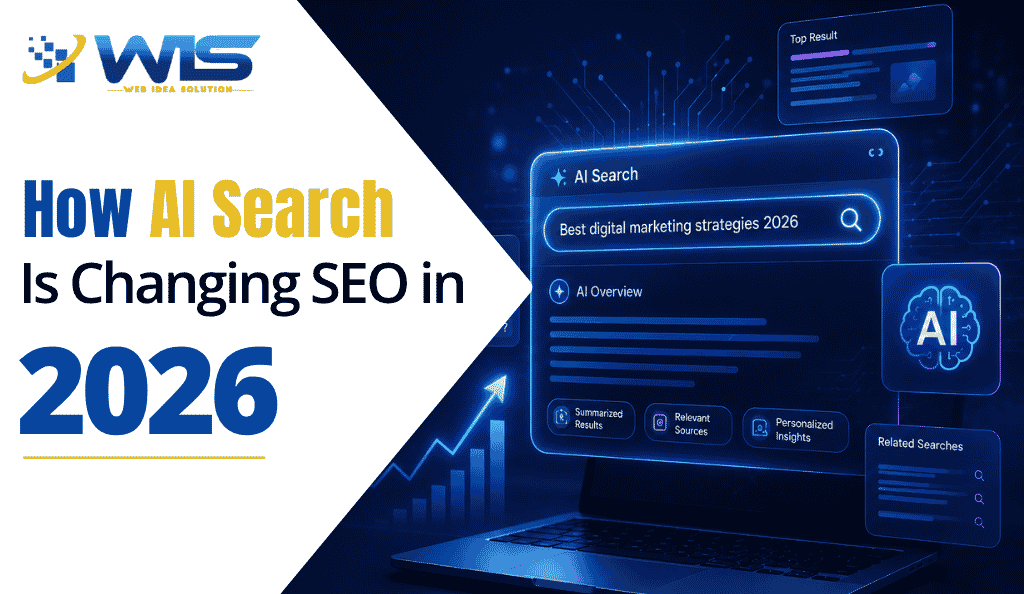
Because today, users are increasingly getting answers before they click. From search pattern to result, everything has changed. Search engines and AI assistants now summarize, compare, recommend, and provide insights directly in the interface.
That shift has created a new discipline: AI Search Optimization.
Brands that understand the rules early win faster.
Let us help you understand how AI search is changing SEO in 2026 and how your brand can get mentioned through AEO & GEO.
SEO Is No Longer Just About Ranking, Rather About Being Referred
For decades, the mission of SEO was straightforward… bring users to your digital platform.
But now search engines are evolving into decision engines.
Today, users ask:
- "What is the best CRM for start-ups?"
- "Which cybersecurity software should I pick?"
- "How does project management software stack up?"
Instead of providing a user with ten options to choose from, AI engines are producing answers to those queries directly. And if your brand gets a mention there, your chances of winning are guaranteed.
Meaning, your website can rank on the first page but still lose attention if AI systems choose someone else as the source. That’s where AI SEO overtakes traditional SEO.
What is AI Search Optimization?
AI Search Optimization is the process of enhancing content so that an AI-driven search engine can understand, trust, and surface your information in its answers.
Unlike traditional SEO, where position on the SERP mattered the most, AI searches are focused more on:
- Content clarity
- Authority signals
- Entity relationships
- Structured content
- Retrieval quality
- User satisfaction
So, the goal is simple: Don’t just appear in search results. Become part of the answer.
The Rise of Generative Search Optimization & Why GEO Matters
A few years ago, SEO services were obsessed with maintaining title tags, optimizing keywords, and building backlinks. And now… another layer has entered the team conversation: Generative Engine Optimization (GEO).
GEO is all about the practice of crafting structured digital content so that AI-powered search engines like Google Gemini, ChatGPT, Copilot, or Perplexity can understand and cite it directly in their answers.
Why GEO Matters
- Zero-Click Searches: With AI technology processing billions of searches, most people receive their answers without even leaving the search window. Without embedding your brand into the AI response, you miss the chance for discovery.
- Authoritative Curation: LLMs prefer information that is well-defined, precise, and easy to merge into an understandable answer. Getting cited by an AI gives instant credibility and authority to users.
- Conversational Intent: Users' complex, multi-layered questions to AI. So GEO also needs optimized, natural, and question-based answers rather than rigid keyword strings.
Why Visibility Looks Different with Google AI Overviews SEO
With Google AI Overviews SEO, users often receive a synthesized answer directly in the search. This has created three major changes:
- Fewer Clicks for Generic Content
- More Opportunity for Expert Content
- Authority Signals Matter More
While average content is losing market share, this is the chance for brands to get into the competition as soon as possible and get mentioned by AI back to back through authoritative content. It starts with a proper website audit and a reliable SEO consultation for your website.
This is also the area where ChatGPT Search Optimization enters.
How?
How Does ChatGPT Search Optimization Help in Visibility?
The number of ChatGPT users for daily searches is growing. As they ask detailed questions, ChatGPT requires a refined answer as well.
If your content provides a detailed yet complete answer to the target users' queries, your chances of performing well in the conversational discovery rise.
You need to maintain:
✔ Clear Question-and-Answer Structure
✔ Strong Topical Coverage
✔ Contextual Depth (What, Why, How)
What Is the New Rule That Influences AI Search Rankings
Search engine algorithms have never set a list of rules to follow to appear in AI search rankings. However, these are the proven rules that experts follow and have seen visible wins as well:
1. Authority Is Becoming More Granular
Publishing 100 average blogs won’t help in creating trust. But crafting 20 highly connected and expert-driven resources will. Both Google algorithms and AI algorithms evaluate the depth of content over volume.
2. Original Thinking Wins
AI can generate summaries from thousands of resources available online. But it struggles to create lived experiences, experiments, frameworks, and opinions.
Add examples, original statistics, show observation, and create intellectual property within your content.
3. Content Architecture Matters More Than Ever
AI systems understand relationships, and your content should make those relationships obvious through topic clusters, internal linking, consistent terminology, and structured headings.
4. User Experience Is Everything to Rank Everywhere
The most important rule is to improve the user experience through fast website loading, an easy-to-navigate interface, and well-structured content. Because if the bounce users bounce because the overall experience feels generic, search systems notice.
The Visibility Framework Brands Should Adopt in 2026
Most brands still operate using the traditional model:
Keyword → Ranking → Traffic → Conversion
However, this model is shrinking, and a stronger AI search optimization model has emerged:
Authority → AI Inclusion → Discovery → Trust → Conversion

What Should You Do Next?
If you are still thinking about SEO in terms of rankings alone, then it is high time for a shift.
As the future of organic traffic won’t be in the hands of the most aggressive publishers, this is the right time for change.
At Web Idea Solution (WIS), we help businesses move beyond conventional SEO with strategies built for the next generation of search, from AI Search Optimization and GEO to authority-driven content and long-term visibility growth.
Connect with us and build a visibility strategy designed for 2026 and beyond!
FAQs
What is AI Search Optimization?
AI Search Optimization refers to the process of optimizing your digital content so that AI-enabled search engines and assistants, like Gemini, ChatGPT, or Copilot, can comprehend, trust, and display your content in their answers, rather than simply ranking the content in searches.
How is AI Search different from traditional Google Search?
The traditional search engine provides you with a set of hyperlinks, but AI-driven search delivers you answers based on multiple sources. The emphasis is now less on getting your click and more on being part of your answer.
What is Generative Engine Optimization (GEO)?
Generative Engine Optimization (GEO) is the process of optimizing visibility within AI-generated responses or getting cited in AI answers as a trusted source. It involves gaining authority, relevance, high-quality content, and the ability to be mentioned by the AI engine more often.
How can I get my website featured in Google AI Overviews?
Generate original, authoritative, and organized content that answers user intents. High topical authority, correct formatting, schema markup, and quality support signals increase the chance of ranking for AI Overviews.
Is SEO still important in 2026?
Yes. SEO remains very important even though the Google AI Overview comes first. It is just evolving. Rather than focusing on keywords, SEO focuses more on intent-based, accurate answers. In fact, success is now easier if you can thoughtfully combine traditional SEO with AI Search Optimization to improve both rankings and AI-driven visibility.
How do I optimize my content for ChatGPT and AI search engines?
Pay attention to crafting experience-based content with high topical depth, well-thought-out structuring, concise answers, personalized opinions, and related topic clusters. Content that reflects expertise has more chances to get noticed by AI systems.
Will AI Search reduce website traffic?
For generic content, traffic may decline as users get instant answers. However, brands producing authoritative and unique content can gain higher-quality traffic and stronger visibility across AI search experiences.
How do AI search engines choose which websites to cite?
Typically, AI search engines place more emphasis on the knowledge, relevancy, authority, freshness, and contextuality of the provided content with respect to the input question. Web pages exhibiting obvious signs of authority tend to be cited more often.