business@webideasole.com

Managing admissions, tracking fee payments, monitoring student performance and delivering online lessons should like multiple disconnected systems?
Not necessarily!
Modern educational institutions work smarter with education ERP and Learning Management Systems (LMS). But only when you choose the right solutions and cut unnecessary costs and operational gaps.
So, education ERP vs LMS: which one does your educational institution actually need? Let us help you understand the right technology to ensure seamless processes and create a better learning experience.
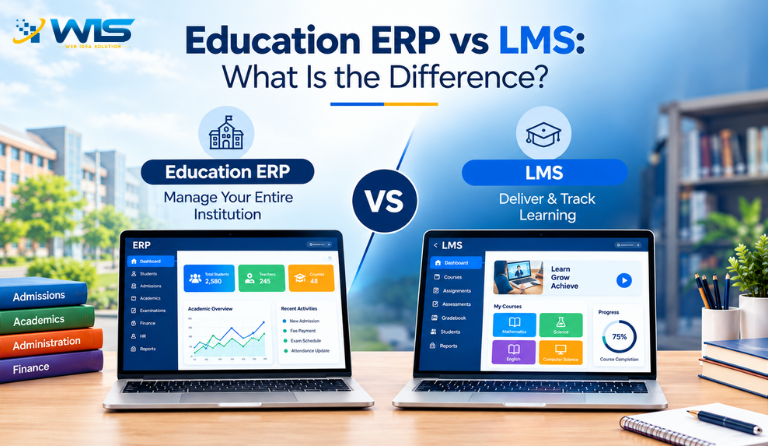
Education ERP Software is a centralized system that integrates an educational institution's administrative, academic, financial, and operational functions. Instead of using separate software for admissions, attendance, fee collection, examinations, employee records, and parent communication, institutions can use one system to manage all these activities.
ERP software acts as the backbone of operations at schools, colleges, and institutions operating from multiple campuses. Every department can operate with its respective data, and at the same time, authorized persons can access their respective records.
Depending on the institution’s requirements, an educational ERP may include:
Not every education ERP includes the same capacities by default. While some platforms offer ready-made modules, others require configuration, third-party integrations or custom EdTech development.
Education ERP supports institutions operating across multiple campuses, where maintaining consistent processes and reliable records becomes increasingly difficult. It is particularly useful for:
Learning Management System is a software solution that is meant to organize, manage and control learning processes. Its main functions include enabling teachers to distribute course material, assign work, evaluate learners' progress, and monitor their performance within the digital learning environment.
Whereas the main focus of ERP is how an organization works, an LMS is oriented towards learning processes.
The learning management system used in schools would enable teachers to upload class notes, carry out assessments, distribute assignments and evaluate the performance of each student.
Common LMS features include:
LMS features also depend on the specific requirements of schools, universities, corporate training providers and online education businesses. That’s why choosing the right EdTech development company matters.
An LMS is useful for schools, colleges, universities, training organizations and particularly every business offering structured learning experiences.
The primary difference between education ERP and LMS lies in their core purposes. Let’s evaluate side-by-side.
|
|
|
|
|
|
|
|
|
|
|
|
|
|
|
|
|
|
|
|
|
|
|
|
|
|
|
|
|
|
|
|
|
|
|
|
|
|
|
|
The choice between school ERP vs LMS becomes easier when you start identifying the solution to potential problems you face.
|
|
Off-the-shelf LMS often restrict your operational workflows, whereas a custom solution is built around your specific business workflow. You may need a custom LMS development if:
✔ Your organization requires specialized user roles, unique learning paths or internal processes that stand out of the box templates can not accommodate.
✔ You need seamless, API-first connections with existing enterprise systems like CRM systems, HR software, video conferencing platforms or custom databases.
✔ If your industry demands specialized built-in compliance frameworks and complete ownership of your data.
✔ You are rapidly scaling your school, university, or digital enterprise.
✔ You need a fully white-labeled platform with custom mobile app capabilities, advanced gamification tools or an AI-powered eLearning platform tailored to your brand.
Integrating ERP and LMS into your existing system helps you exchange data and provide students, teachers and administrative staff with a seamless experience.
The ERP handles student admissions, program registrations, fee details, and academic information. The LMS handles e-learning material, assignment submissions, online exams, and course status.
With a properly designed integration, you can sync student and course enrolment information, provide students with access to the correct learning resources, exchange relevant assessment or completion data, and support consolidated reporting where the systems' data and reporting models allow it.
Choosing between education ERP and LMS is only the first step. The real challenge is finding a solution that fits your institution’s workflow, connects existing systems and supports future growth without adding unnecessary complexity.
That’s where the right education software development company makes a difference. From deployment of Education ERP software solutions to developing a customized LMS platform, through to ERP & LMS integration, the right technology partner can transform your needs into reality.
At Web Idea Solution, we help businesses build technology solutions around their specific operational needs. Whether you are modernising school management, developing an online learning platform or connecting multiple educational systems, our team of experts specializes in identifying the right approach for specific needs.
Connect with us to discuss your requirements and explore the right technology solution for your institution.
An education ERP takes care of administrative activities like admission, fees, attendance, and employee management. On the other hand, an LMS is about education and learning using course material, assignments, testing, and monitoring.
Not necessarily. Schools that primarily need administrative automation may start with an ERP, while those focusing on digital learning may need an LMS. Institutions requiring both operational management and advanced learning tools can benefit from using both systems together.
Some common modules include student management, admissions, fees collection, attendance, examinations, employee management, parent interface, and reporting. The availability of the modules depends on the particular software company.
The main functions provided by an LMS include course administration, digital learning resources, assignments, testing, evaluations, monitoring of learners' progress, and feedback. Some LMSs additionally provide virtual classroom and personalized learning features.
Yes. They can be integrated using APIs or other forms of integration to share information about students, their enrollment, and academic records. Another option is that an integrated software solution could have both ERP and LMS features.
Through integration, duplicate data entry can be avoided, and relevant student data will be easily accessible. The teacher does not have to manage several disconnected systems, and the students receive an improved digital experience through consistency.
Absolutely. The LMS provides tools to assist educational establishments in conducting lessons online, sharing materials, collecting tasks, evaluating progress, and assessing performance. This technology is capable of supporting both purely online and blended learning environments.
Premade software is usually appropriate for general needs and quick installation. Custom education software should be considered if an organization has specific workflows, custom integrations, or functionality not covered by available solutions.
Costs associated with software development depend on the number of modules, number of users, level of customization, number of interfaces, security needs, and infrastructure. Requirements analysis is the most effective tool for determining development costs.
Assess their expertise in educational technology, technological know-how, integration ability, security measures, scalability, and support. Select a partner who appreciates your process and provides sensible solutions, avoiding unnecessary custom programming.



Reach out, we’d love to hear from you!