business@webideasole.com

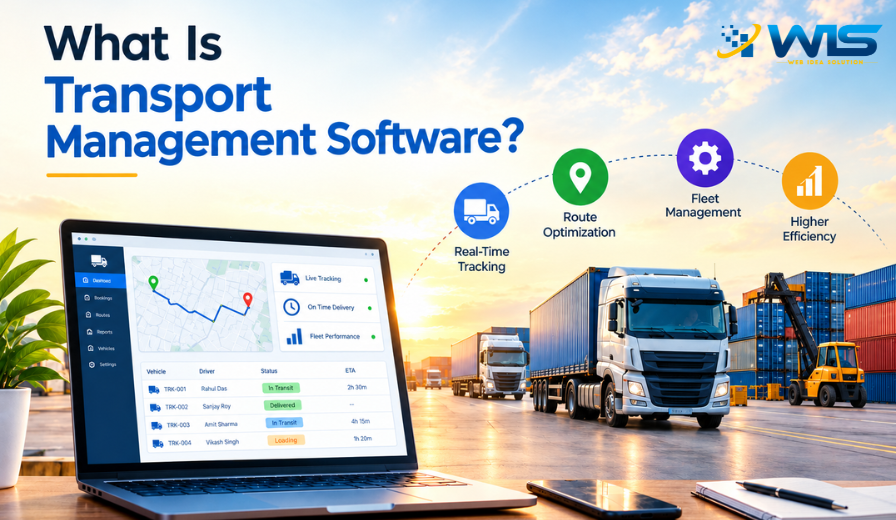
Managing transport operations is a strategic challenge for businesses operating logistics. Businesses need to manage pressure on lead times and rising costs, as well as high customer expectations. A Transport Management System (TMS) solves these challenges, streamlining the transport operations.
But what exactly is a TMS? What features does it have? And how can businesses benefit from using it? This article will cover all these points as well as any other questions that businesses might have before making a decision on choosing a TMS.
A transportation management system (TMS) is a software solution that helps businesses plan, execute, and optimize their transport operations like physical movement of goods. It centralizes data on shipments, costs, carriers and routes within a single platform, ensuring that the shipment is compliant and proper documentation is available.
A TMS integrates various transportation processes into a single platform. It centralizes data and automates workflows to optimize transportation planning, execution, and management. A TMS system often works with other software as part of the business’s supply chain management system. Here's a step-by-step overview of how a TMS typically works:
1. Entering orders: First, customer orders are entered either manually or automatically through order management systems into the TMS.
2. Planning and Optimization: After all the orders are entered into the system, the TMS identifies the best way to fulfil them. Then, the TMS plans the most efficient routes, selects carriers and optimizes the load. It ensures that maximum efficiency is maintained in this process.
3. Execution: Once the planning is done, the TMS moves on to executing the plan. It tenders shipments to selected carriers. The process starts with generating shipping documents, then scheduling pickups, and finally coordinating with carriers to ensure that shipments are dispatched on time.
4. Tracking and Monitoring: After an order is dispatched, the TMS tracks and monitors the order in real time. In this way, the business remains aware of the current status of the orders and can make necessary adjustments.
5. Freight Audit and Payment: After the order is delivered, TMS automates the freight audit and payment process. This is done by matching invoices with shipment details, auditing freight bills for accuracy, and processing payments to carriers.
6. Reporting and Analysis: Finally, the TMS generates reports and provides analytics on transportation performance. This data then can be used for identifying trends, assessing carrier performance, and making informed decisions about future transportation strategies.
Transport businesses often suffer from problems such as inefficient routing that leads to high fuel costs and delays in delivery of orders. Moreover, the companies utilize their vehicle capacities poorly, which leads to more trips to the same location. TMS solves all these issues by optimizing routes and choosing the best carrier with the lowest rates.
Furthermore, the businesses don't have real-time visibility on the live status of the orders, due to which customers often lack transparency. Another problem is that ensuring driver compliance manually is difficult. Both of these issues are solved by the TMS as it enables real-time order tracking and freight audits.
All the customer orders are captured by the TMS from various sources such as web portals, emails, or direct ERP integrations. Then, orders at similar locations are grouped, and rates across different carriers are compared. Based on this, transport booking is done once the best carrier is selected.
A TMS helps businesses plan and optimize their transportation routes. It considers factors like distance, traffic conditions, fuel costs, and delivery windows, through which the TMS can significantly reduce transit times and fuel consumption.
Through a TMS, businesses can compare different carriers based on their cost, performance, and levels of service. In this way, the companies can select the best vehicle for each of the shipments. Moreover, it also provides tools for managing driver contracts as well as compliance.
A TMS has a dispatch management system that assigns loads, optimizes routes, as well as coordinates drivers and vehicles. It ensures that goods are transported efficiently from the warehouse to the customer while providing real-time tracking and proof of delivery.
Once a shipment is dispatched, a TMS tracks its live location and provides visibility all the way from the origin to the destination. Any issues like delays are notified immediately to the shipper and the customers also get updates about the shipment status in real-time.
After the customer receives the goods, as proof of the successful delivery, digitally verifies that a shipment has reached its destination safely and on time. The drivers can collect digital signatures or use features like geotagging to ensure this process is successful completed.
TMS automates the entire financial lifecycle of freight operations. It automates the freight audit and payment process to generate accurate bills for clients. In this way, the software reduces scope for error, eliminates any possibility for overpayment, ultimately improving financial control.
TMS has comprehensive reporting and analytics capabilities, which provide insights into key performance indicators (KPIs) such as carrier performance, transportation costs, and on-time delivery rates. Through this process, companies can make decisions by identifying trends and future needs.
Adopting a TMS can revolutionaries the current way a business manages their transport operations. It directly affects their revenues and customer satisfaction. All the benefits of TMS are listed below:
Lower Costs: Businesses can save a significant amount of money by reducing shipping expenses as well as administrative expenses. This is because TMS saves fuel costs by optimizing routes and carrier charges by choosing the best rates. Moreover, the software reduces billing errors with freight audits and lowers operating costs with load optimization.
Higher customer satisfaction: Since companies can meet customer expectations by delivering the goods within the promised timeframe, it directly impacts customer satisfaction. Moreover, customers are also able to track any updates with their delivery, which is a direct effect of the transparency enabled by the TMS.
Business decision making: Businesses using TMS have a significant advantage over others that have not adopted the software. As it enables the companies to track their goods in real time, they can immediately act on any delays or unforeseen events in the delivery process.
Businesses that need to ship, move, and receive goods on a regular basis use the transport management system regularly. Some examples of these businesses are:
Businesses looking for supply chain software often get confused between Transport Management Software and Fleet Management Software. Although they might look similar on the surface, they are used for different purposes.
A Transportation Management System (TMS) is a platform that helps to plan, execute, and optimize the movement of goods. It focuses on managing shipments, optimizing routes, selecting the best carrier, and tracking delivery in real time.
In contrast, Fleet management software aims to manage and monitor vehicles and drivers. It focuses on vehicle tracking, maintenance, fuel management, and driver behavior. Businesses that own and operate a fleet of vehicles such as delivery services, taxi companies, and transport providers mainly use Fleet Management software.
Choosing the right TMS for your business is no easy task, as you will need to consider the size of your business, your needs and your budget. Here is a list of factors that you will need to consider to choose the best TMS:
TransitERP helps in managing various aspects of the transport operations of a business such as route and carrier optimization, supply chain visibility, freight cost management, accessibility through cloud, along with KPI monitoring and analytics. From analyses of the best route available between the origin and the destination point to tracking the order in real time, you can have complete information about lane, delivery times and destination points..
Also the cloud-based offers increased accessibility of the software for business using any kind of device- PC, Mac, smartphones or tablets. Therefore, businesses can access the information they need at anytime from anywhere.
Ready to simplify your transport management while having greater control over every trip, fleet & route?
Transport Management Software (TMS) is a software that helps businesses plan, execute, and optimize transport operations like physical movement of goods, ensuring shipments are compliant and properly documented.
A TMS works by capturing order data from various sources, evaluating the most cost-effective carriers, and optimizing the routes. It then digitally dispatches the shipments, tracks their status real-time, and automatically audits the final invoices.
There is no difference between transport management software and a TMS. TMS is the acronym for Transportation Management System (or Transport Management Software). They are the exact same thing.
The main features of TMS include optimising routes and carrier costs. Additionally, it helps in real-time shipment tracking with freight auditing.
A TMS reduces costs by grouping smaller shipments to avoid higher freight rates and minimizing fuel expenses by choosing the best route. It also lowers administrative costs by automatically catching billing mismatches and overpayment for carriers.
Yes, a transport management software can manage vehicles and drivers. While detailed vehicle maintenance is usually handled by dedicated fleet software, a TMS manages the daily operations of both vehicles and drivers.
Yes, transport management software (TMS) fully supports both trip planning and vehicle dispatch as its core operational functions.
Yes, a transport management software automates the entire billing cycle by matching incoming carrier bills against original quotes. After it is verified, it instantly generates customer invoices using proof-of-delivery.
Manufacturers, distributors, e-commerce retailers, and 3rd party or 4th party logistics providers who regularly ship large volumes of physical goods should use TMS (transport management software).
You should choose the right transport management software based on factors such as accessibility, integration with existing transport management system, scalability, reliability, and good technical support.



Reach out, we’d love to hear from you!